Attacks are made using ranged or melee weapons. Attacks can be made one at a time or, in some cases, you can roll for multiple attacks together (see Hints and Tips - Fast Dice Rolling section).
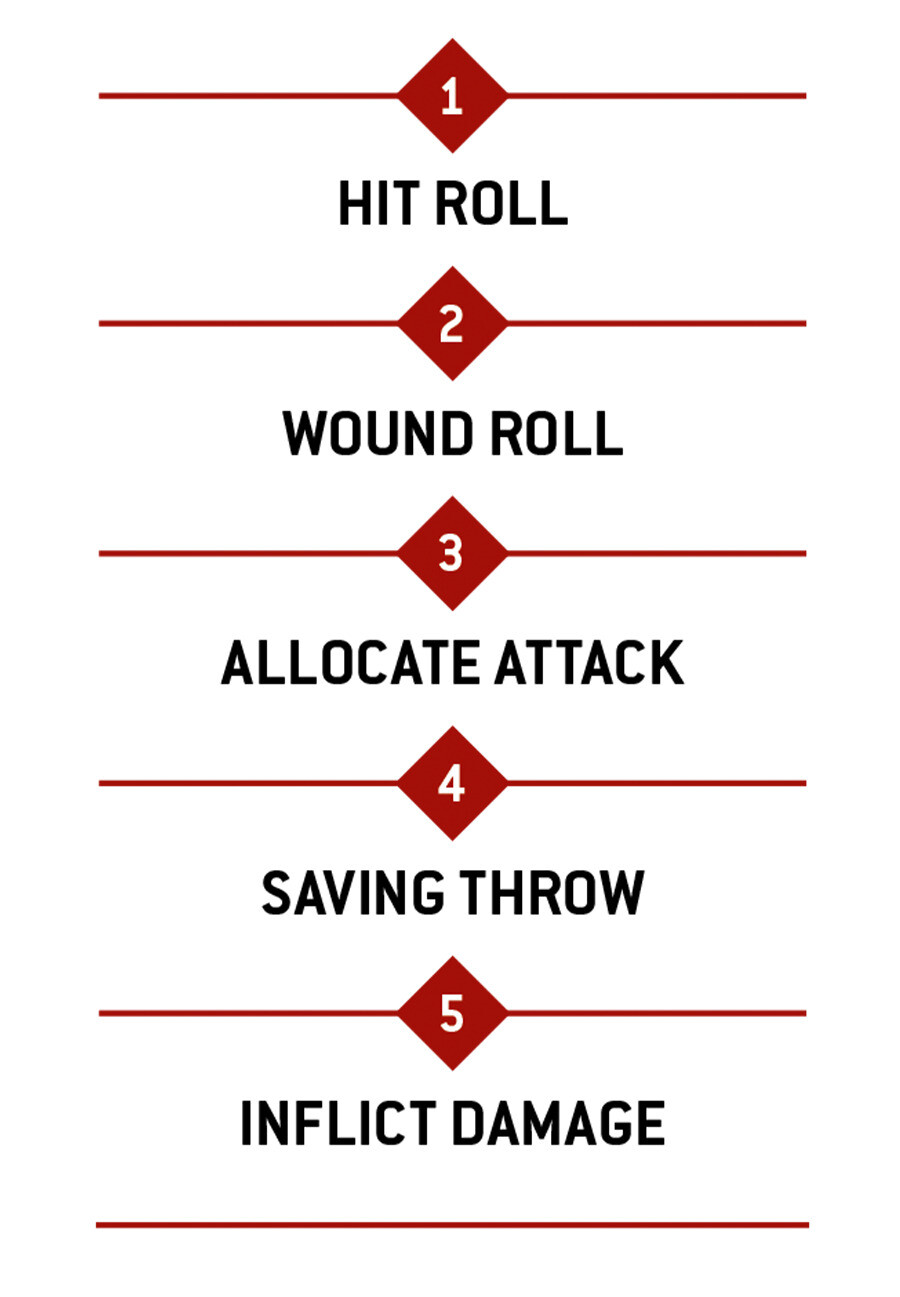
Use the following sequence to make attacks one at a time.
When a model makes an attack, make one Hit roll for that attack by rolling one D6. If the result of the Hit roll is greater than or equal to the attack’s Ballistic Skill (BS) characteristic (if the attack is being made with a ranged weapon) or its Weapon Skill (WS) characteristic (if the attack is being made with a melee weapon), then that Hit roll is successful and scores one hit against the target unit. Otherwise, the attack fails and the attack sequence ends.
An unmodified Hit roll of 6 is called a Critical Hit and is always successful. An unmodified Hit roll of 1 always fails. A Hit roll can never be modified by more than -1 or +1.
Critical Hit: Unmodified Hit roll of 6. Always successful.
Hit Roll (Melee Attack): A hit is scored if the D6 result equals or exceeds that attack’s WS.
Hit Roll (Ranged Attack): A hit is scored if the D6 result equals or exceeds that attack’s BS.
An unmodified Hit roll of 1 always fails.
A Hit roll can never be modified by more than -1 or +1.
Each time an attack scores a hit against a target unit, make a Wound roll for that attack by rolling one D6 to see if that attack successfully wounds the target unit. The result required is determined by comparing the attack’s Strength (S) characteristic with the target’s Toughness (T) characteristic, as shown below
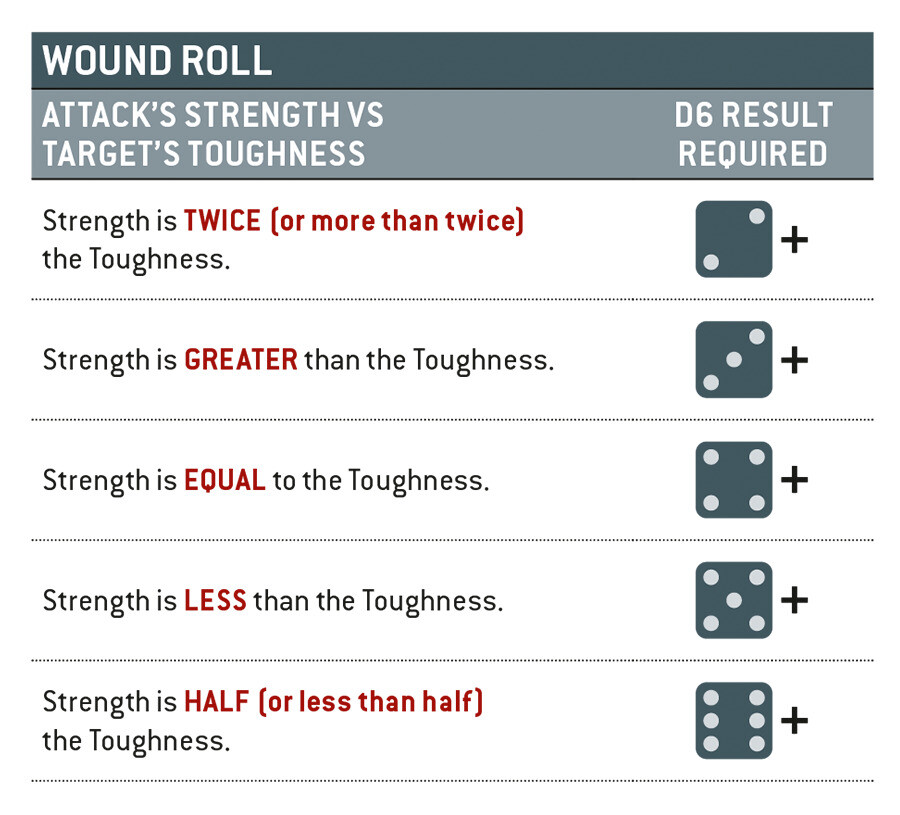
If the result of the Wound roll is greater than or equal to the required number shown in the table opposite, then that Wound roll is successful and scores one wound against the target unit. Otherwise, the attack fails and the attack sequence ends.
An unmodified Wound roll of 6 is called a Critical Wound and is always successful. An unmodified Wound roll of 1 always fails. A Wound roll can never be modified by more than -1 or +1.
A Wound roll can never be modified by more than -1 or +1.
An unmodified Wound roll of 1 always fails.
Critical Wound: Unmodified Wound roll of 6. Always successful.
If an attack successfully wounds the target unit, the player controlling the target unit allocates that attack to one model in the target unit, as follows.
If a model in the target unit has already lost one or more wounds, or has already had attacks allocated to it this phase, that attack must be allocated to that model. Otherwise, that attack can be allocated to any model in the target unit. Note that it does not matter if that model is visible to or within range/Engagement Range of the attacking model.
If a model in the target unit has already lost any wounds or had other attacks allocated to it this phase, the attack must be allocated to that model.
The player controlling the target unit then makes one saving throw. By default, this will be an armour saving throw using their model’s Save (Sv) characteristic, but some models have invulnerable saves that can be used instead (see below). To make an armour saving throw, roll one D6, then modify the result by the Armour Penetration (AP) characteristic of the attack. For example, if the attack has an AP of -1, then 1 is subtracted from the saving throw.
If the result is greater than or equal to the Save characteristic of the model the attack was allocated to, then that saving throw is successful and the attack sequence ends. Otherwise, that saving throw fails and that model suffers damage (see Inflict Damage section).
An unmodified saving throw of 1 always fails. A saving throw can never be improved by more than +1.
An unmodified saving throw of 1 always fails.
Saving Throw: Roll one D6 and modify by the attack’s AP. If the result is less than the Save of the model being rolled for, the saving throw is failed and that model suffers damage. Otherwise, that attack is saved.
A saving throw can never be improved by more than +1.
Invulnerable Saves
Whether shielded by force fields, enveloped in mystical energies or simply possessed of preternatural senses and lightning-fast reflexes, some warriors are protected by more than mere physical armour.
Some models have an invulnerable save listed on their datasheet. Each time an attack is allocated to a model with an invulnerable save, the controlling player must choose to use either that model’s Save characteristic or its invulnerable save, but not both. If a model has more than one invulnerable save, it can only use one of them – choose which it will use.
Unlike armour saving throws (which use a model’s Save characteristic), invulnerable saving throws are never modified by an attack’s Armour Penetration characteristic, but otherwise follow the normal rules for saving throws.
Invulnerable Save: Never modified by an attack’s AP
The controlling player can choose to use either a model’s invulnerable save or its Save characteristic.
The damage inflicted is equal to the Damage (D) characteristic of the attack. A model loses one wound for each point of damage it suffers. If a model’s wounds are reduced to 0 or less, it is destroyed and removed from play. If a model loses several wounds from an attack and is destroyed, any excess damage inflicted by that attack is lost and has no effect.
A model loses a number of wounds equal to the attack’s Damage characteristic.
If a model is destroyed by an attack, any excess damage inflicted by that attack is lost.
Mortal Wounds
Some attacks are so powerful that no armour or force field can withstand their fury.
Some rules inflict mortal wounds on units. Each time mortal wounds are inflicted on a unit, each of those mortal wounds inflicts one point of damage to that unit, and they are always applied one at a time. Each mortal wound is allocated to a model in the same manner as allocating an attack. Excess damage from mortal wounds is not lost if the damage can be allocated to another model. Instead, keep allocating damage to another model in the target unit until either all the damage has been allocated or the target unit is destroyed.
If an attack inflicts mortal wounds in addition to any normal damage, do not make a Wound roll or saving throw (including invulnerable saving throws) against those mortal wounds. If those mortal wounds are inflicted by an attack that has the [PRECISION] ability, the attacking model’s controlling player can allocate those mortal wounds to a CHARACTER model in that unit.
If mortal wounds are being inflicted as a result of the [HAZARDOUS] ability or by an attack with the [DEVASTATING WOUNDS] ability that scored a Critical Wound, each time those mortal wounds are allocated to a model, if that model is destroyed as a result of those mortal wounds, the remaining mortal wounds from that attack are lost, just as with a normal attack.
If, when a unit is selected to shoot or fight, one or more of its attacks can inflict mortal wounds on the target, resolve any normal damage inflicted by the attacking unit’s attacks on that target before inflicting any mortal wounds on that target. If an attack inflicts mortal wounds in addition to any normal damage, but the normal damage is subsequently saved, the target unit still suffers those mortal wounds, as described above.
Mortal wounds inflicted by attacks always apply after any normal damage, even if that damage was saved.
No saving throws can be made against mortal wounds.
Each mortal wound inflicted on a unit causes one model in that unit to lose one wound.
Unless the source of the mortal wounds is the [HAZARDOUS] ability or an attack with the [DEVASTATING WOUNDS] ability, damage from mortal wounds is not lost if it can be allocated to another model.
Some models have ‘Feel No Pain x+’ listed in their abilities. Each time a model with this ability suffers damage and so would lose a wound (including wounds lost due to mortal wounds), roll one D6:if the result is greater than or equal to the number denoted by ‘x’, that wound is ignored and is not lost. If a model has more than one Feel No Pain ability, you can only use one of those abilities each time that model suffers damage and so would lose a wound.
Feel No Pain x+: Each time this model would lose a wound, roll one D6:if the result equals or exceeds ‘x’, that wound is not lost.
Some models have ‘Deadly Demise x’ listed in their abilities. When such a model is destroyed, roll one D6 before removing it from play (if such a model is a TRANSPORT, roll before any embarked models disembark). On a 6, each unit within 6"of that model suffers a number of mortal wounds denoted by ‘x’ (if this is a random number, roll separately for each unit within 6").
Deadly Demise x: When this model is destroyed, roll one D6. On a 6, each unit within 6"suffers ‘x’ mortal wounds.
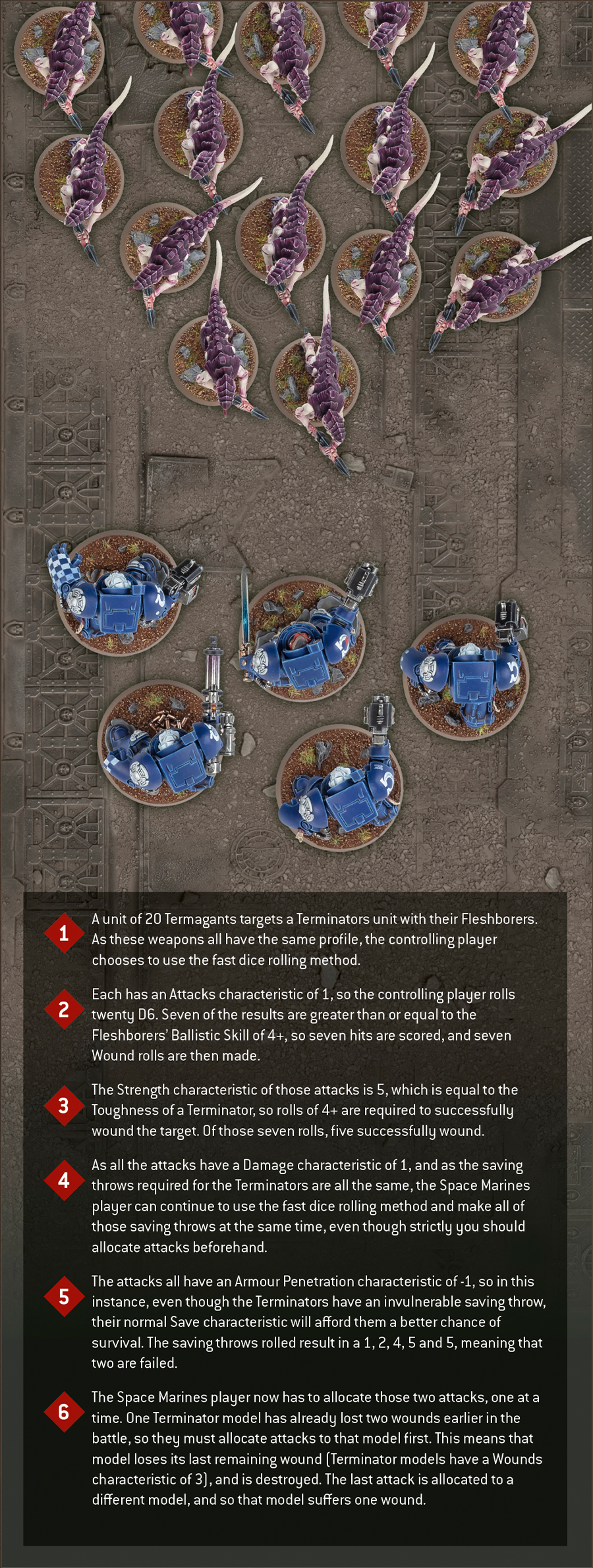
The rules for making attacks have been written assuming you will resolve them one at a time. However, it is possible to speed up your battles by rolling the dice for similar attacks together. In order to make several attacks at once, all of the attacks must have the same Ballistic Skill (if it’s a ranged attack) or the same Weapon Skill (if it’s a melee attack). They must also have the same Strength and Armour Penetration characteristics, they must inflict the same Damage, they must be affected by the same abilities, and they must be directed at the same unit. If this is the case, make all of the Hit rolls at the same time, then all of the Wound rolls. Your opponent can then allocate the attacks one at a time, making the saving throws and suffering damage each time as appropriate.
Note that if all the models in the target unit would require the same saving throw against the attacks, and the order in which the attacks are allocated would make no difference, then your opponent can make all their saving throws at the same time, and can do so as soon as the Wound rolls have been made. If they do, they then allocate the attacks that resulted in failed saving throws one at a time, inflicting the damage as appropriate even though, strictly speaking, saving throws should be made after attacks have been allocated. In any case, remember that if the target unit contains a model that has already lost any wounds or has already had attacks allocated to it this phase, the controlling player must allocate further attacks to that model until either it is destroyed, or all the attacks have been saved or resolved.
If the attacks being allocated to a target inflict random damage, you cannot use the fast dice rolling approach exactly as stated above – you will need to roll the dice one at a time. Consider several attacks with a Damage characteristic of D3 being allocated to a target containing models with two wounds each. As excess damage is lost each time a model is destroyed, the order in which the attacks are allocated and resolved becomes important. If the results of those D3s were 1, then 2, then 3, the attacks would result in a total of two destroyed models, but applying them in the order 3, then 2, then 1 would result in two models being destroyed and a third being damaged with only one wound remaining. As such, the rolls should be made one at a time.