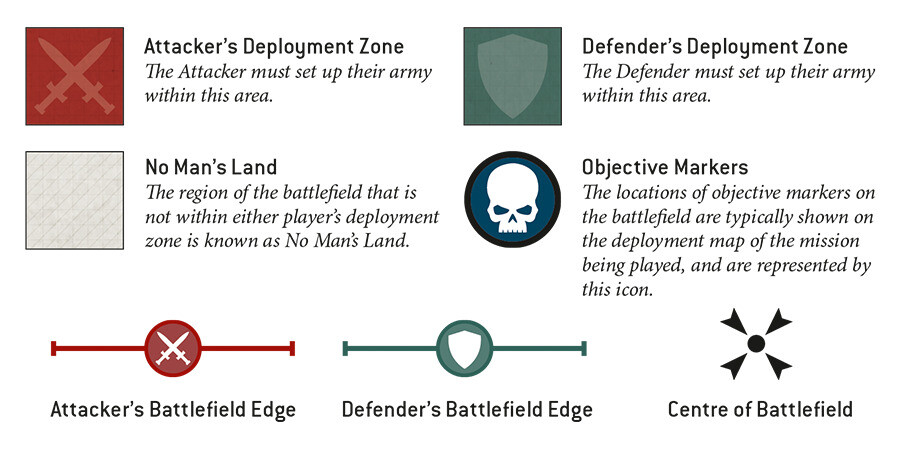
Objective markers represent objects of tactical or strategic import that both sides are attempting to secure, such as valuable artefacts, vital supplies or communications nodes. If a mission uses objective markers, it will state where they are located on the battlefield. These can be represented using any suitable marker, but we recommend using round markers that are 40mm in diameter.
When setting objective markers up on the battlefield, place them so they are centred on the point specified by the mission. When measuring distances to and from objective markers, measure to and from the closest part of them. Models can move over objective markers as if they were not there, but they cannot end a move on top of an objective marker.
At the start of the battle, each objective marker on the battlefield is said to be contested, and so is not controlled by either player. To control an objective marker, a player will first need to move models within range of it. A model is within range of an objective marker if it is within 3"horizontally and 5"vertically of that objective marker.
Every model has an Objective Control (OC) characteristic listed on its datasheet. To determine a player’s Level of Control over an objective marker, add together the OC characteristics of all the models from that player’s army that are within range of that objective marker. A player will control an objective marker at the end of any phase or turn if their Level of Control over it is greater than their opponent’s. If both players have the same Level of Control over an objective marker, that objective marker is contested.
Models cannot end a move on top of an objective marker.
Level of Control: Add together the OC characteristics of all of a player’s models within range of the objective marker.
A model is within range of an objective marker if within 3"horizontally and 5"vertically.
An objective marker is controlled by the player with the highest Level of Control over it (in a tie, it is contested).